For many international travelers, Yokohama is not simply a place to visit.
It is where a journey through Japan begins — or where it ends.
A cruise ship arrives in Yokohama in the morning.
You disembark with your suitcases.
Your flight from Haneda or Narita may not leave until the evening.
And suddenly there is an important question:
What should we do between the cruise terminal and the airport?
Some travelers want to go directly to the airport.
Others would rather spend their final hours in Japan exploring Tokyo, shopping, enjoying Japanese food or visiting one more destination before flying home.
And some cruise passengers are not leaving Japan at all.
They may be starting a private tour to Kamakura, Hakone or Mt. Fuji, continuing to a Tokyo hotel, or returning to the cruise ship after a shore excursion.
That is why transportation from Yokohama’s cruise terminals is not always just a simple transfer.
Sometimes it becomes part of the final — or first — day of the Japan journey.
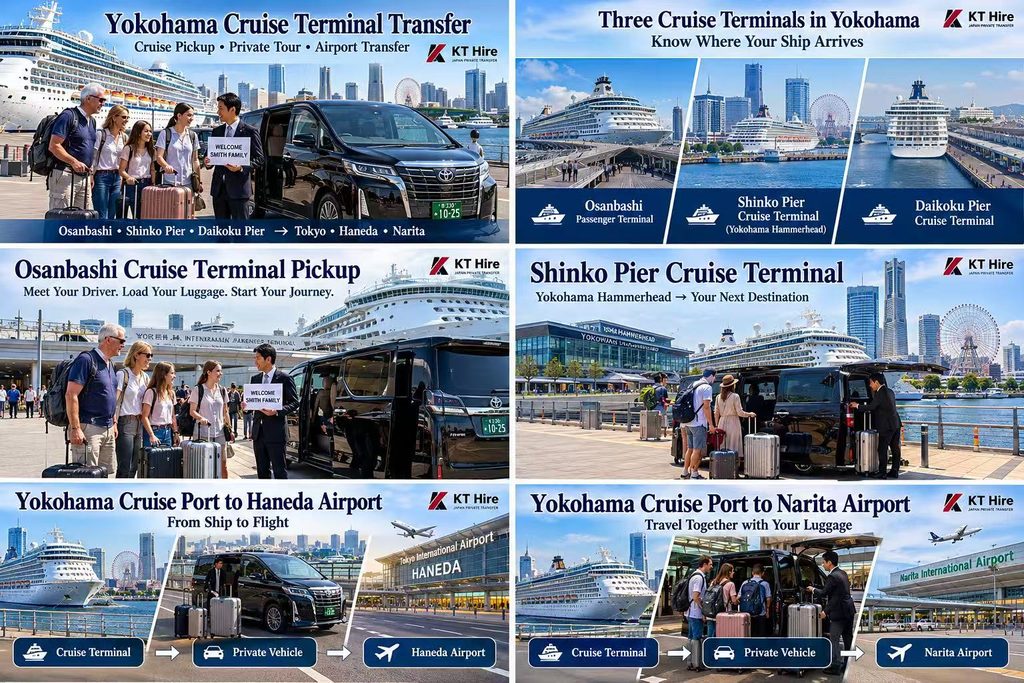
Three Main Cruise Terminals in Yokohama
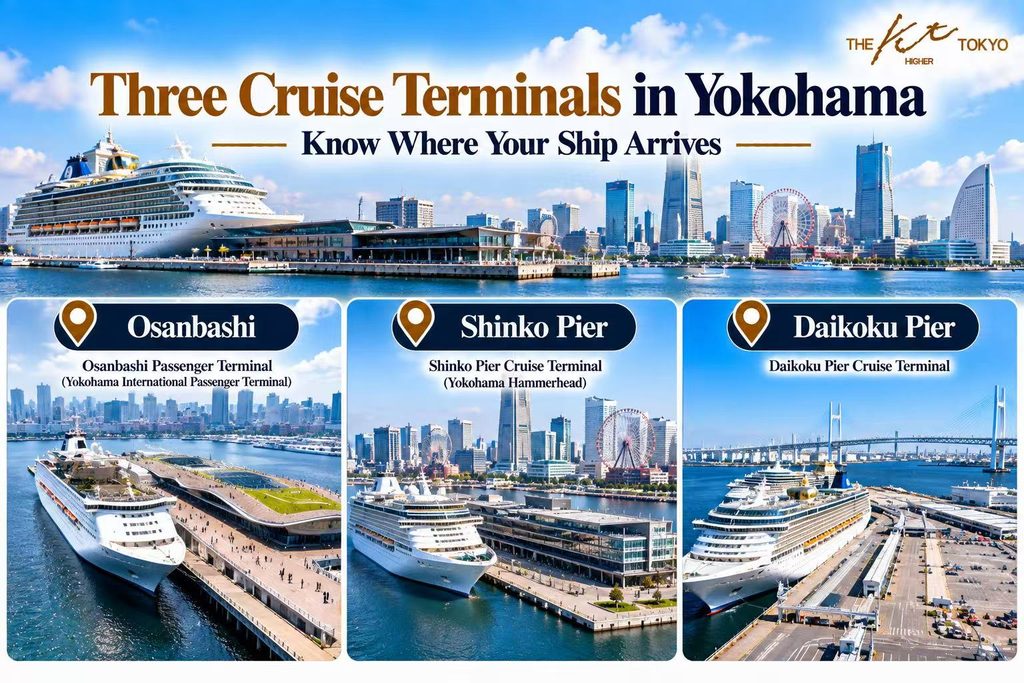
Yokohama Port has three main cruise terminals:
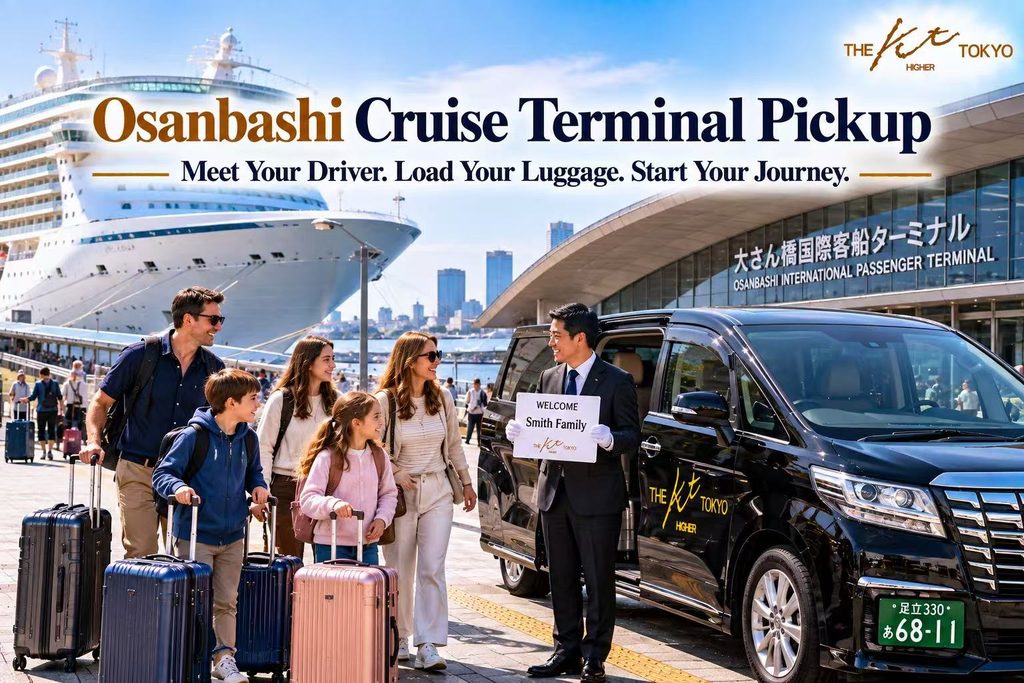
Osanbashi Passenger Terminal
(Yokohama International Passenger Terminal)
Shinko Pier Cruise Terminal
(Yokohama Hammerhead)
Daikoku Pier Cruise Terminal
Each terminal has different surroundings and access conditions.
Osanbashi is close to central Yokohama and approximately a five-minute walk from Nihon-odori Station.
Shinko Pier is in the Minato Mirai waterfront area, with Bashamichi, Minatomirai and Sakuragicho stations within walking distance.
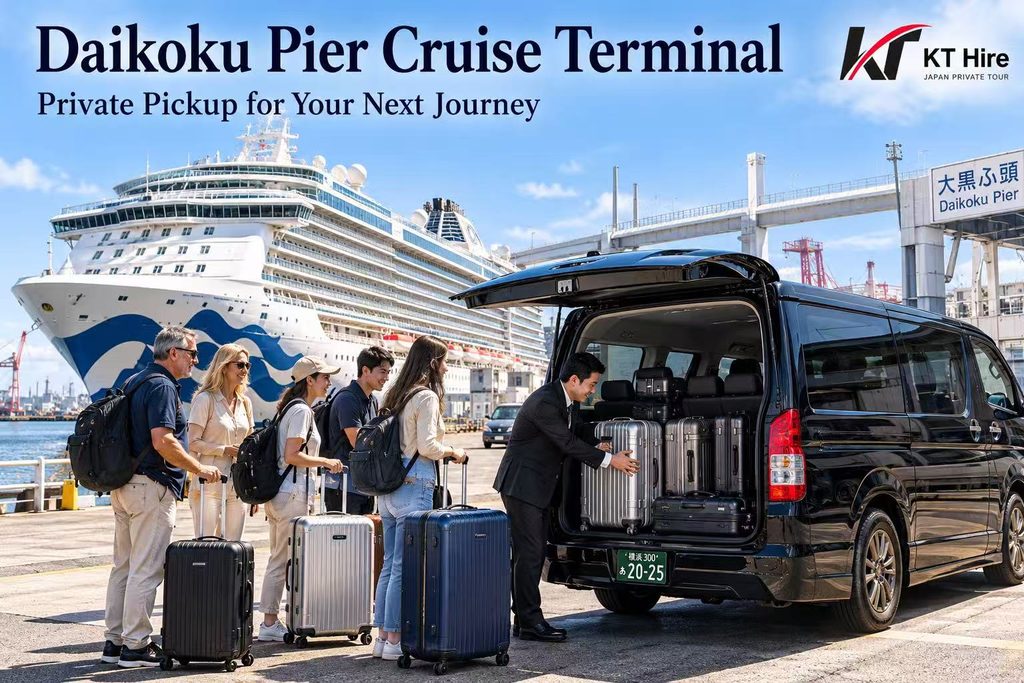
Daikoku Pier is different. It is located farther from the central waterfront area and is designed to accommodate very large cruise ships, making vehicle transportation particularly useful for arriving passengers.
Osanbashi Passenger Terminal Transfer
Osanbashi is perhaps the Yokohama cruise terminal most international travelers immediately associate with the city.
Its full English name is:
Osanbashi Passenger Terminal
(Yokohama International Passenger Terminal)
From here, travelers can easily continue toward central Yokohama, Tokyo, Haneda Airport or other destinations.
But the best transportation choice depends on what happens after you leave the ship.
A couple traveling with one suitcase may be perfectly comfortable using public transportation.
A family of five or six with several large suitcases may have a very different experience.
For them, meeting one vehicle at the cruise terminal and traveling together can remove several small but inconvenient steps.
Shinko Pier Cruise Terminal — Yokohama Hammerhead
The second major terminal is:
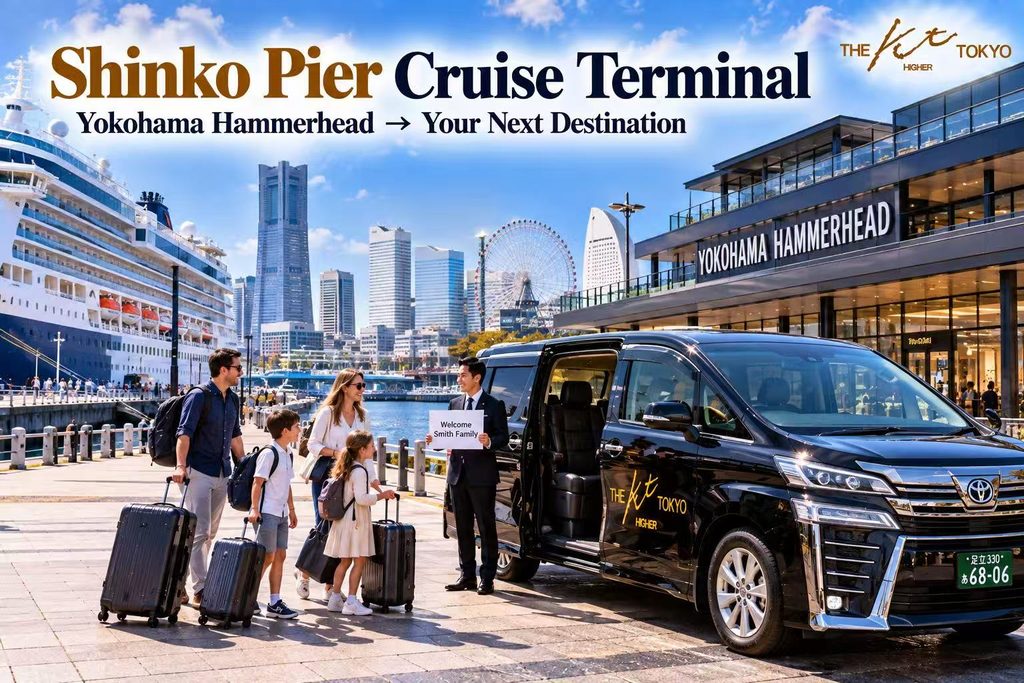
Shinko Pier Cruise Terminal (Yokohama Hammerhead)
This terminal opened in 2019 and forms part of a waterfront complex with restaurants, shops and a hotel. It is also close to Yokohama Red Brick Warehouse and the Minato Mirai area.
For cruise passengers with a few hours before their next journey, this location gives several possibilities.
You might enjoy Yokohama first.
You might continue directly to Tokyo.
Or you might meet your vehicle at the terminal and begin a longer private sightseeing itinerary.
Daikoku Pier Cruise Terminal
Daikoku Pier is the third major cruise terminal in Yokohama.
It was developed to accommodate mega cruise ships that cannot pass beneath the Yokohama Bay Bridge because of their height.
Unlike Osanbashi and Shinko Pier, Daikoku Pier is not located beside the main sightseeing areas of central Yokohama. The city lists taxi connections to nearby railway stations, and vehicle access therefore becomes especially relevant for cruise passengers arriving here.
For families or groups with several suitcases, arranging transportation before arrival can make the next part of the journey much simpler.
Yokohama Cruise Terminal to Haneda Airport
One of the most straightforward journeys is:
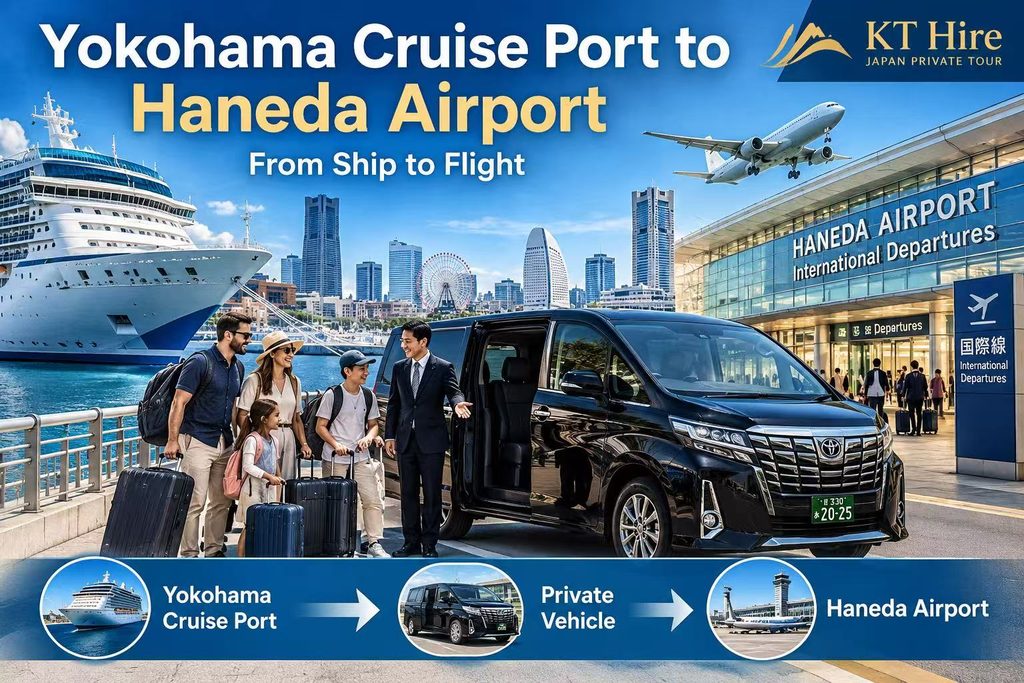
Yokohama Cruise Terminal → Haneda Airport
For travelers with a flight soon after disembarkation, going directly to Haneda may be the simplest choice.
But cruise arrivals do not always match airline departure times perfectly.
Imagine disembarking in the morning while your international flight leaves in the evening.
Going directly to the airport might mean spending many hours waiting inside the terminal.
That is when another option becomes interesting.
Instead of treating the day as:
Cruise Ship → Airport
you can think of it as:
Cruise Ship → Sightseeing / Shopping / Lunch → Haneda Airport
Your luggage travels with you in the vehicle, while the final few hours in Japan become part of the trip rather than waiting time.
Yokohama Cruise Terminal to Narita Airport
Narita Airport is farther from Yokohama, so timing becomes more important.
The official Yokohama Port information gives a general reference of roughly 90 minutes between the cruise terminals and Narita by bus or taxi, although actual road travel can vary considerably depending on traffic and the specific terminal.
For passengers flying from Narita, we normally think backward from the flight time.
First, determine when you should arrive at the airport.
Then allow an appropriate road-traffic buffer.
Only after that should sightseeing be added.
This is especially important when combining a cruise arrival with a private tour.
A good itinerary is not the one with the largest number of attractions.
It is the one that gets you to your flight comfortably.
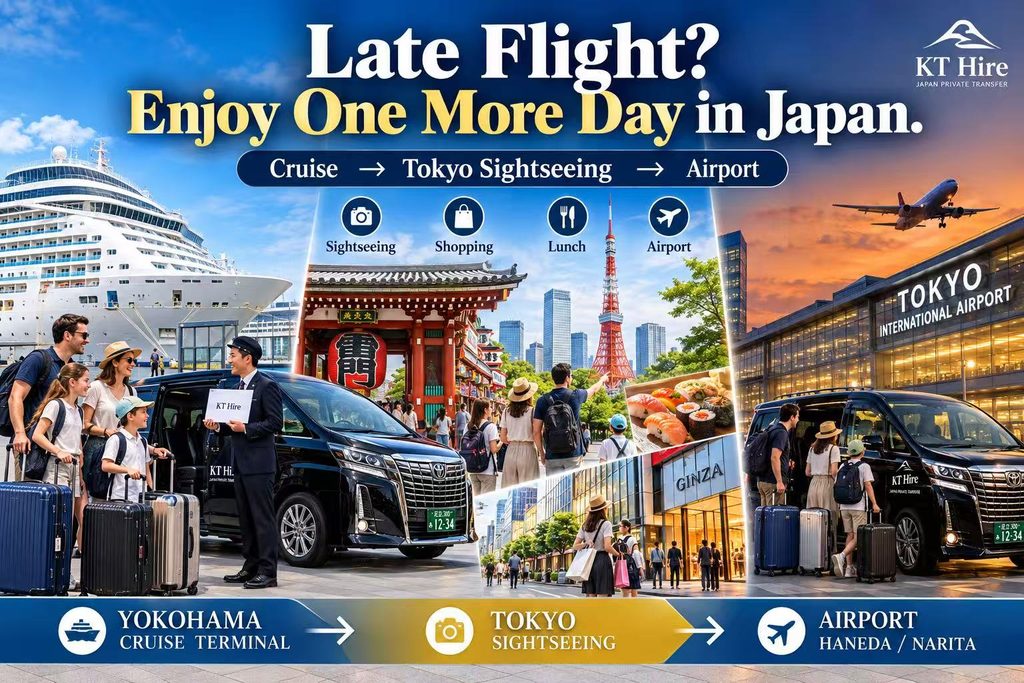
Cruise Terminal → Tokyo Sightseeing → Airport
This is one of the most useful options for travelers with an evening flight.
After leaving the cruise ship in the morning, a private vehicle can take you into Tokyo.
Depending on available time and your interests, your final day might include places such as:
Asakusa
Tokyo Skytree area
Ginza
Tsukiji Outer Market
Shibuya
or simply shopping and a good Japanese meal.
You do not necessarily need to visit five or six attractions.
Sometimes one or two places, lunch and a little shopping create a much more relaxing final day.
Afterward:
Tokyo → Haneda Airport
or
Tokyo → Narita Airport
becomes the final section of the journey.
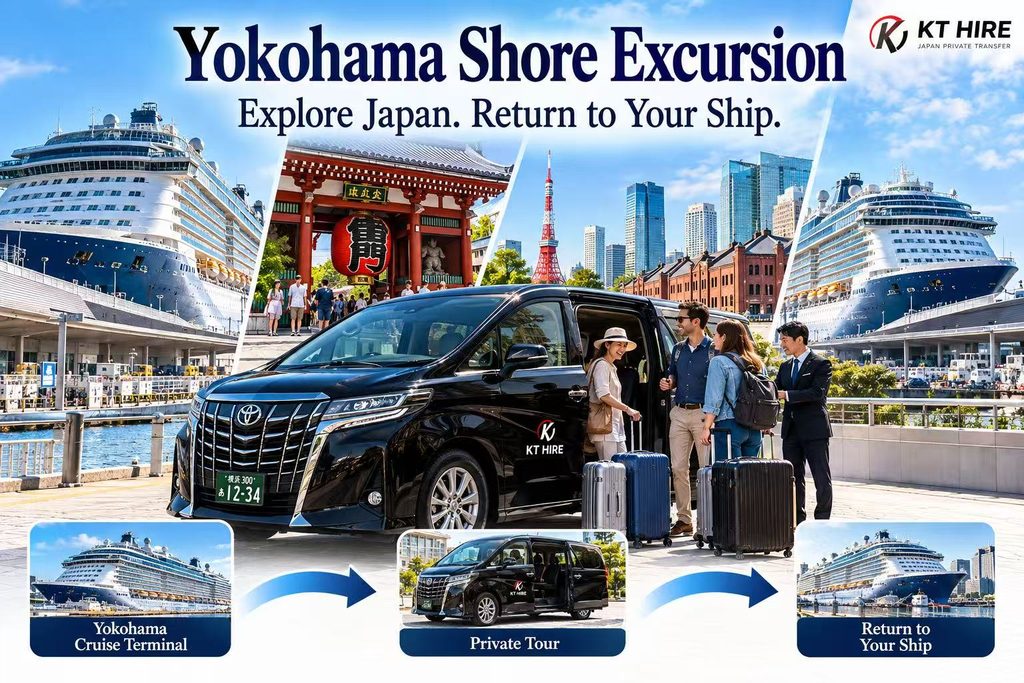
Yokohama Cruise Shore Excursion and Return to the Ship
Not every passenger is disembarking permanently.
Some cruise ships stop in Yokohama for the day before continuing their voyage.
In that case, passengers may want a private Yokohama cruise shore excursion and then return to the same terminal before departure.
Possible itineraries depend heavily on the ship’s schedule.
A shorter visit might focus on Yokohama or Tokyo.
With a longer port stay, destinations farther away may also become possible.
The most important information is always the ship’s required return time.
A shore excursion should be planned backward from that deadline with enough buffer for road traffic and port procedures.
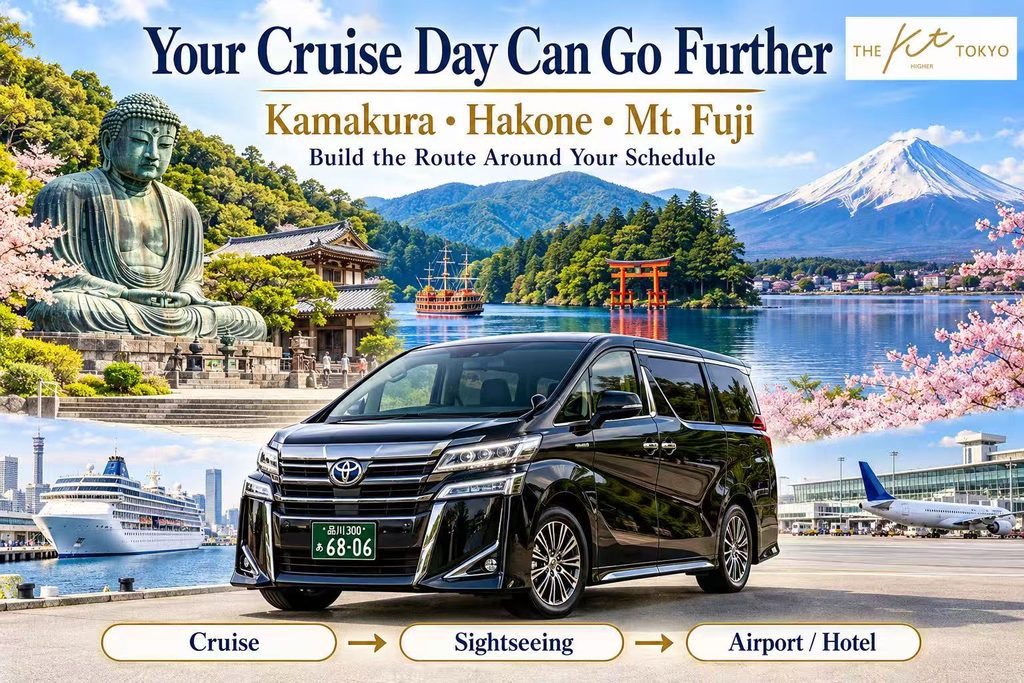
Yokohama Cruise Terminal to Kamakura
Kamakura can work particularly well for travelers who want something different from central Tokyo.
A possible itinerary is:
Cruise Terminal → Kamakura → Enoshima → Airport / Tokyo Hotel
Temples, traditional streets and the coastal atmosphere create a very different final impression of Japan.
For travelers who have already spent several days in Tokyo before their cruise, this can be more interesting than repeating the same city attractions again.
Yokohama Cruise Terminal to Hakone or Mt. Fuji
Some travelers ask whether they can leave the cruise terminal, visit Hakone or Mt. Fuji and then continue to an airport or hotel.
The answer is:
sometimes, yes — but the schedule matters.
These are longer itineraries.
Weather, traffic, cruise disembarkation time and flight departure time all need to be considered.
For example:
Yokohama Cruise Terminal → Hakone → Tokyo Hotel
or
Yokohama Cruise Terminal → Mt. Fuji / Lake Kawaguchi → Tokyo
can make sense when you have enough time.
But trying to add Mt. Fuji before an international flight departing only a few hours later would not be a sensible itinerary.
Private transportation provides flexibility, but it cannot remove distance or traffic.
Traveling with Cruise Luggage
Luggage is one of the biggest differences between a normal sightseeing day and a cruise-transfer day.
Two travelers may have two large suitcases.
A family may have four, six or even more pieces.
A larger group can quickly have enough luggage that using several taxis becomes inconvenient.
When requesting a private vehicle, it helps to send:
Number of passengers
Number of large suitcases
Number of carry-on bags
Stroller or wheelchair information if applicable
Child-seat requirement
Vehicle choice should be based not only on passenger capacity, but also on luggage.
A vehicle that technically seats everyone may not have enough practical luggage space.

Meeting Your Driver at the Yokohama Cruise Terminal
Cruise-terminal pickup is slightly different from a normal hotel pickup.
Passengers first need to leave the ship and complete the required arrival procedures.
The exact exit and vehicle-access situation can also vary depending on the terminal and port operations that day.
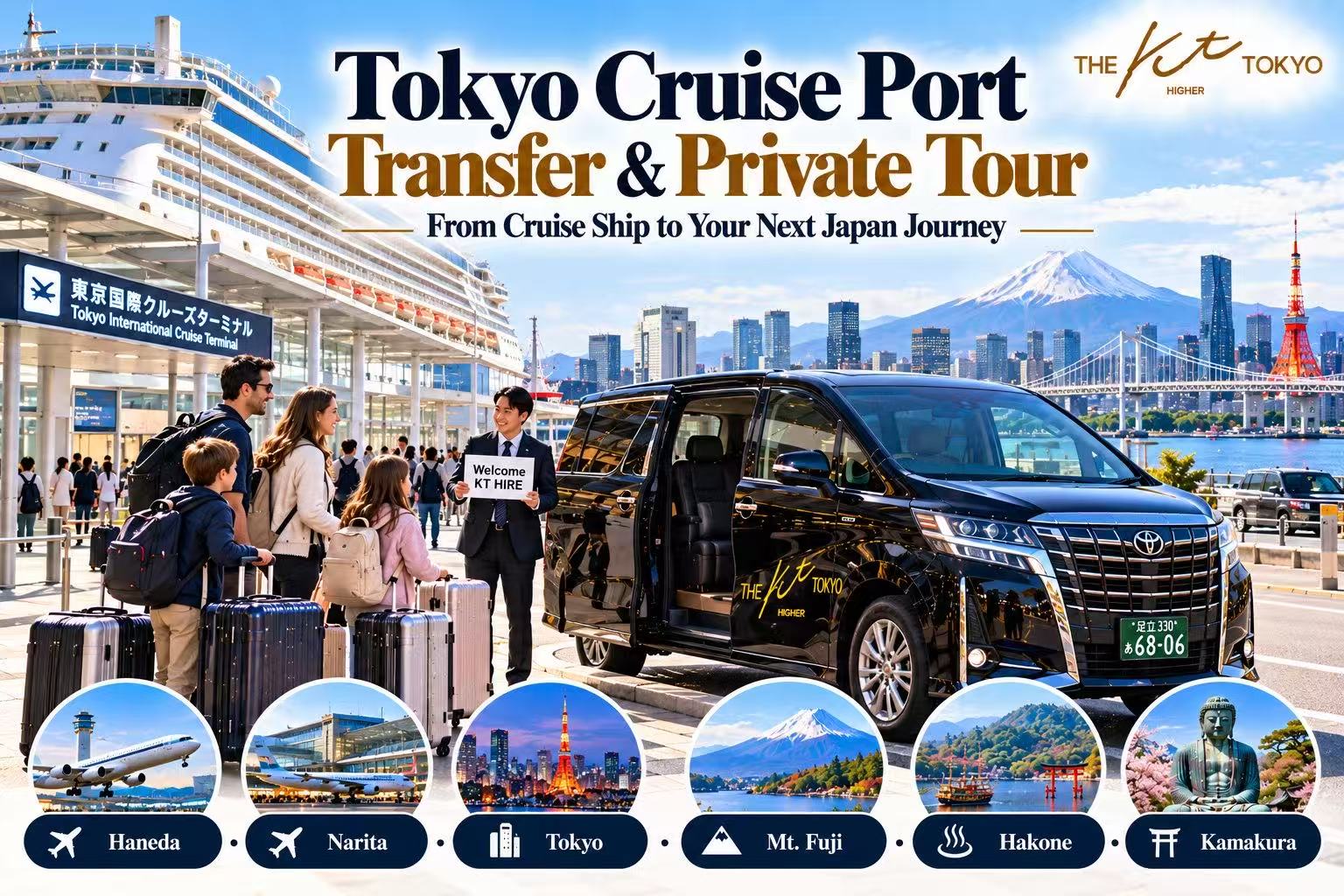
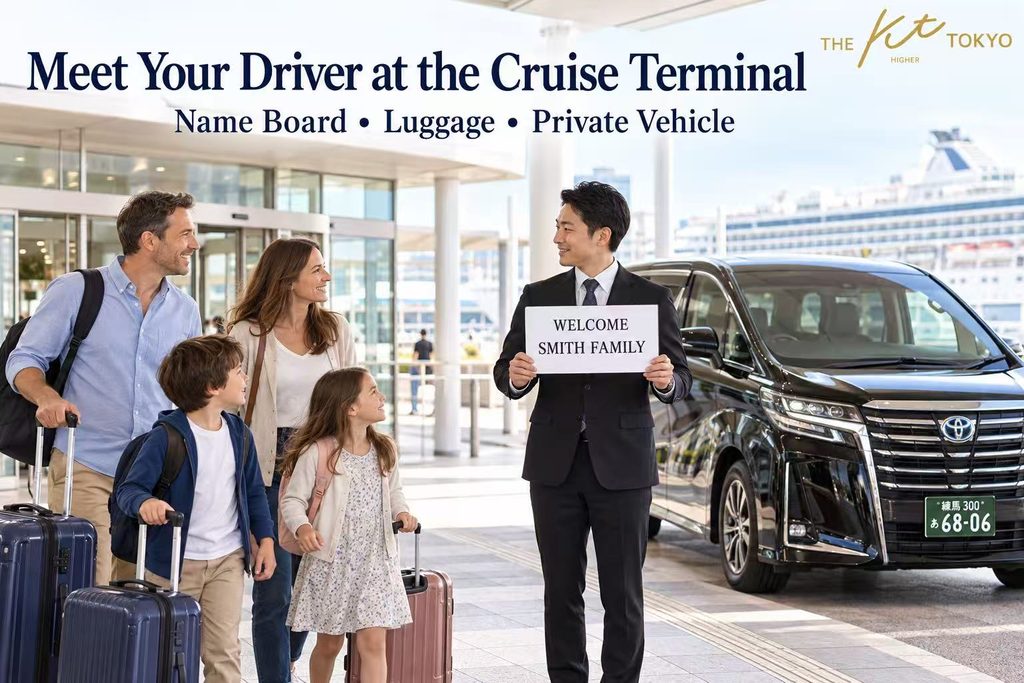
For KT Hire cruise pickups, a complimentary name-board service can be arranged.
When terminal access and parking conditions allow, the driver can meet passengers around the designated terminal meeting area.
If the vehicle needs to wait elsewhere, the meeting method can be coordinated in advance.
Providing the following information helps make the pickup smoother:
Cruise ship name
Terminal name
Arrival date
Expected disembarkation time
Passenger name
Number of passengers
Luggage quantity
Next destination or flight information
This is particularly important in Yokohama because simply writing “Yokohama Cruise Terminal” is not enough.
You should confirm whether your ship is arriving at:
Osanbashi
Shinko Pier
or
Daikoku Pier
before arranging transportation.
Cruise Pickup + Tour + Airport Drop-Off
For many travelers, this combination makes the most sense:
Cruise Terminal Pickup
→ Private Sightseeing
→ Lunch / Shopping
→ Airport Drop-Off
Instead of booking separate transportation for every section, the same vehicle can stay with the group throughout the itinerary.
This is particularly useful when traveling with children, elderly family members or several suitcases.
It also means your schedule can be built around the most important fixed times:
your cruise disembarkation
and
your flight departure
Everything between those two times can then be planned realistically.
Private Transportation Is Not the Only Option
Yokohama has good public transportation.
Osanbashi and Shinko Pier are close enough to railway stations that many travelers can comfortably continue by train or bus. Yokohama is also well connected with central Tokyo, Haneda and Narita.
Private transportation is simply another option.
It becomes particularly useful when:
you are traveling as a family or group,
you have several large suitcases,
you want to make sightseeing stops before the airport,
you need door-to-door transportation,
or your journey involves several destinations.
The question is not whether a private vehicle is always better.
The question is whether it makes your particular cruise itinerary easier.
Yokohama Is More Than a Place to Leave the Ship
Yokohama’s cruise season continues to bring international ships and passengers to the city. For autumn 2026 alone, Yokohama announced that five cruise ships would make their first-ever calls at the port during October.
For some passengers, Yokohama is the end of a cruise.
For others, it is the beginning of another journey.
From the three main cruise terminals, your next destination might be:
Haneda Airport
Narita Airport
Tokyo
Kamakura
Hakone
Mt. Fuji
or simply a restaurant, shopping district or hotel before the next stage of your trip.
If you are arranging transportation after a cruise, it is helpful to send the complete schedule rather than only asking for a terminal-to-airport transfer.
The ship arrival time, terminal, flight time, passenger count, luggage and places you would like to visit all matter.
Sometimes the most memorable part of a cruise journey happens after you have already left the ship.
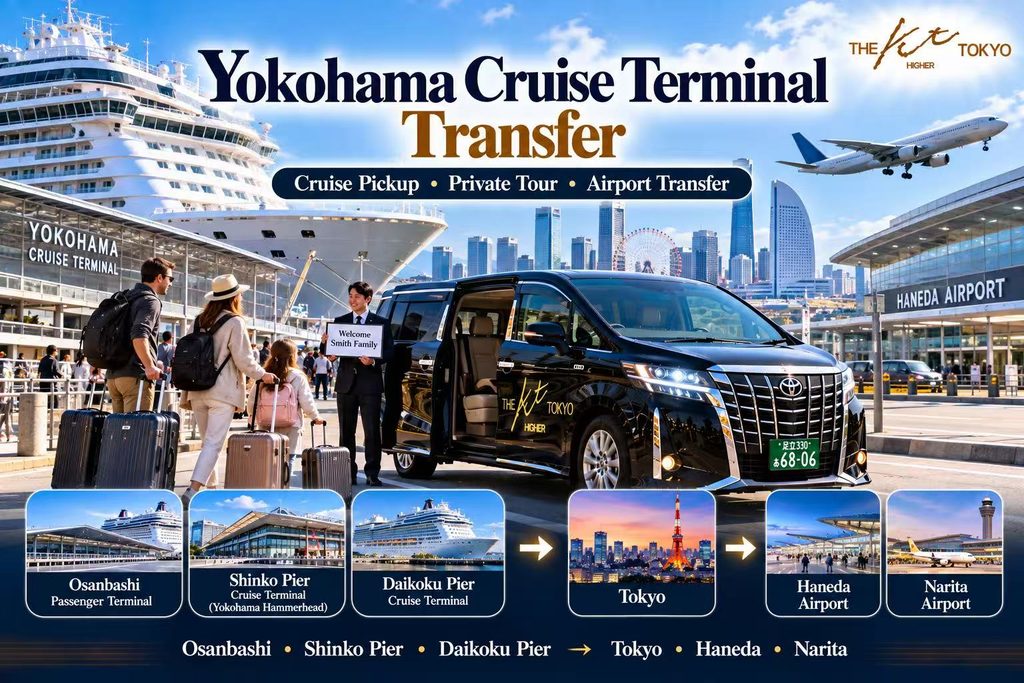
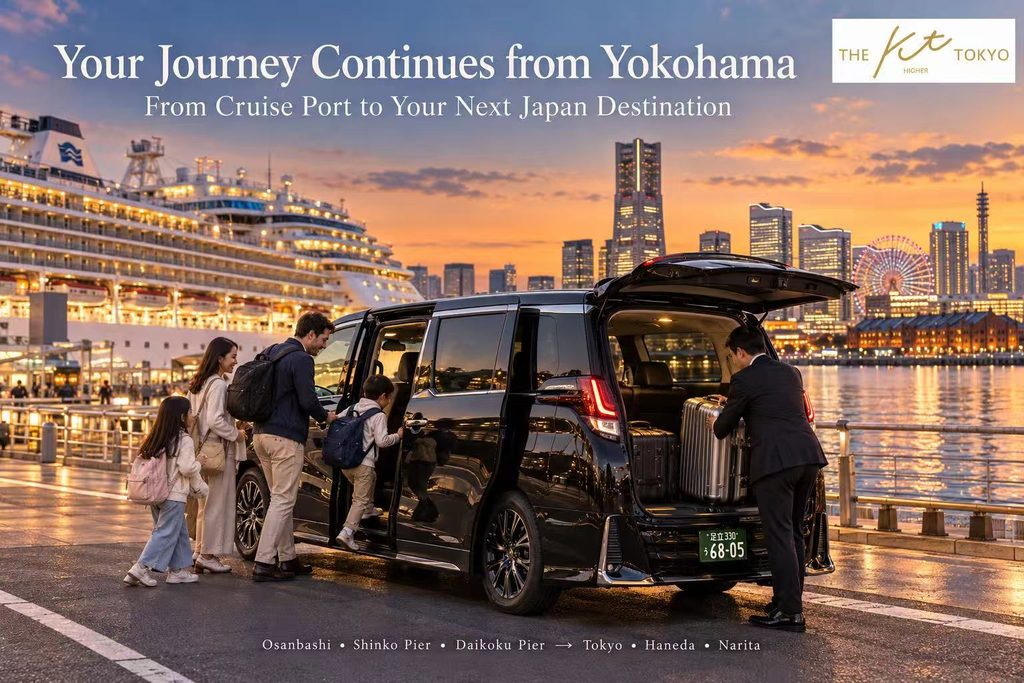
Osanbashi • Shinko Pier • Daikoku Pier → Tokyo • Haneda • Narita • Your Next Japan Journey
FAQ
Q1. Which Yokohama cruise terminals can you pick up from?
Private pickup can be arranged from Yokohama’s three main cruise terminals:
Osanbashi Passenger Terminal (Yokohama International Passenger Terminal)
Shinko Pier Cruise Terminal (Yokohama Hammerhead)
Daikoku Pier Cruise Terminal
When making a reservation, please send your cruise ship name, arrival date, terminal name and expected disembarkation time.
Q2. Can you take us directly from Yokohama Cruise Port to Haneda or Narita Airport?
Yes. Private transfers can be arranged from Yokohama cruise terminals directly to Haneda Airport (HND) or Narita International Airport (NRT).
This can be especially convenient for families and groups traveling with several large suitcases because everyone and their luggage can travel together in one suitable vehicle.
Q3. Our cruise arrives in the morning but our flight is in the evening. Can we go sightseeing first?
Yes, if your flight schedule allows enough time.
A typical itinerary might be:
Yokohama Cruise Terminal → Tokyo Sightseeing → Haneda Airport
or
Yokohama Cruise Terminal → Lunch / Shopping → Narita Airport
Your luggage can remain in the vehicle while you enjoy your remaining time in Japan. The sightseeing schedule should always be planned backward from the airport arrival time with enough allowance for road traffic.
Q4. Can we visit Kamakura, Hakone or Mt. Fuji after leaving the cruise ship?
Yes, depending on your disembarkation time, final destination and flight schedule.
Possible itineraries include:
Yokohama Cruise Terminal → Kamakura / Enoshima → Tokyo or Airport
Yokohama Cruise Terminal → Hakone → Tokyo Hotel
Yokohama Cruise Terminal → Mt. Fuji / Lake Kawaguchiko → Tokyo
Longer routes such as Hakone or Mt. Fuji require sufficient time, so they are better considered as part of the complete itinerary rather than added at the last minute.
Q5. Can we book a Yokohama shore excursion and return to the same cruise ship?
Yes. If your cruise is making a port call in Yokohama rather than ending there, a private shore excursion can be arranged with return transportation to the cruise terminal.
The itinerary should be based on your ship’s required return time. A comfortable safety margin should always be included for traffic and port procedures.
Related Articles
A. September 21, 2026
Tokyo & Yokohama Cruise Port Private Transfer | Airport, Hotel, Mt. Fuji & Shore Excursions
Tokyo & Yokohama Cruise Port Private Transfer | KT Hire | KT株式会社
B. October 2, 2026
Tokyo Cruise Port Transfer & Private Tour | Haneda, Narita, Mt. Fuji, Hakone & Kamakura
Tokyo Airport to Hakone Ryokan | Haneda & Narita Private Transfer | KT株式会社
C. September 30, 2026
Tokyo Airport to Hakone Ryokan | Private Transfer from Haneda & Narita with Luggage
Tokyo Airport to Hakone | Private Transfer from Haneda & Narita | KT株式会社