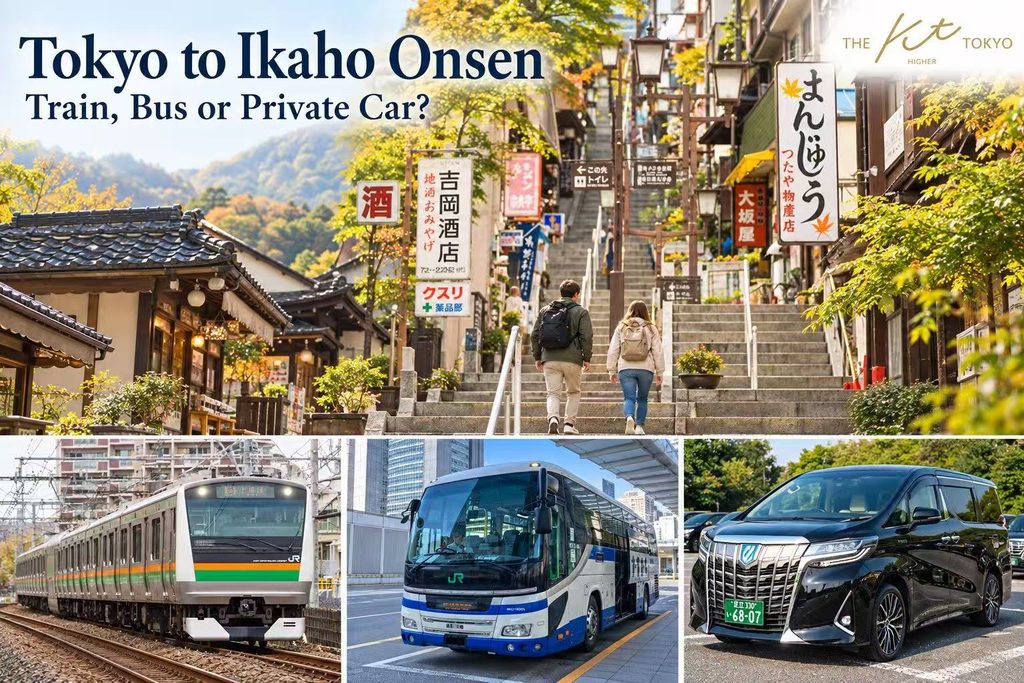
The right way to travel from Tokyo to Ikaho Onsen depends on your starting point, luggage and budget. Train-and-bus connections and highway buses offer practical public transport options. A taxi or pre-booked private car can take you closer to your ryokan entrance.
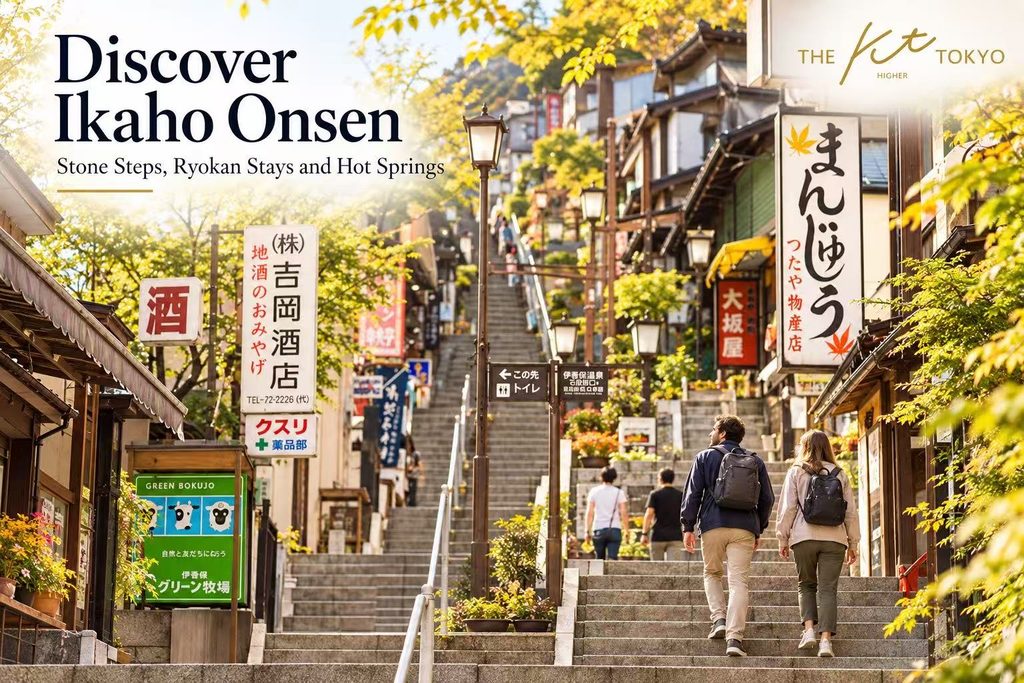
Ikaho Onsen is a hillside hot spring town in Gunma Prefecture. Its famous stone steps connect small shops, restaurants and traditional inns. An overnight stay adds a different rhythm to a Japan itinerary: a village walk, time at your accommodation and a relaxed evening.
You can travel directly from an airport, visit after several days in Tokyo, or continue from accommodation in Hakone or Kawaguchiko.
Ikaho’s central stone stairway has 365 steps. Exploring the surrounding streets is part of the experience, with places to pause for refreshments and enjoy the town’s atmosphere.
The area is also known for two spring-water types: Kogane no Yu, or “golden water,” and Shirogane no Yu, or “silver water.” The golden water develops its characteristic brownish color from its iron content.
Bathing facilities, spring-water sources and meal arrangements differ between properties. Check your chosen ryokan’s details rather than assuming every accommodation offers the same experience.
An overnight visit gives you time to enjoy the town after daytime visitors leave. It also allows you to plan the journey around check-in and dinner.
The public transport fares below are adult, one-way prices per person. Taxi estimates refer to one vehicle. KT Hire private transfers are quoted separately for your itinerary.
Rail examples use ordinary-class conventional JR trains unless stated otherwise. They do not include optional Green Car seating, a Shinkansen supplement or a limited-express supplement.
The rail-and-bus arrival benchmark is Ishidangaiguchi, the bus stop beside Ikaho’s stone steps. Highway buses may list the stop as Ikaho Ishidangai. Another useful stop is Ikaho Onsen, also called Miharashishita.
These stops are not interchangeable for every hotel. Ask your ryokan which stop to use and whether a shuttle is available. Walking, a local taxi or an advance shuttle reservation may be necessary.
Journey allowances include a modest amount of connection time where indicated. They exclude the final transfer to your accommodation. Airport immigration, baggage collection and customs take additional time before you board transport.
Fares and timetables can change. Check the linked operators before purchasing tickets.
A conventional-rail route connects Haneda Terminal 3 with Ikaho through Shinagawa, Takasaki and Shibukawa.
Travel in this order:
The JR conventional-rail fare from Shinagawa through Takasaki to Shibukawa is ¥2,420 when purchased as one through journey.
Total reference fare: ¥3,500 per adult.
Changes: three, at Shinagawa, Takasaki and Shibukawa. Choose services carefully, as another connection may be necessary on some departures.
Planning allowance: approximately 3½–4½ hours from the airport station, including ordinary connection time. Long waits can extend this.
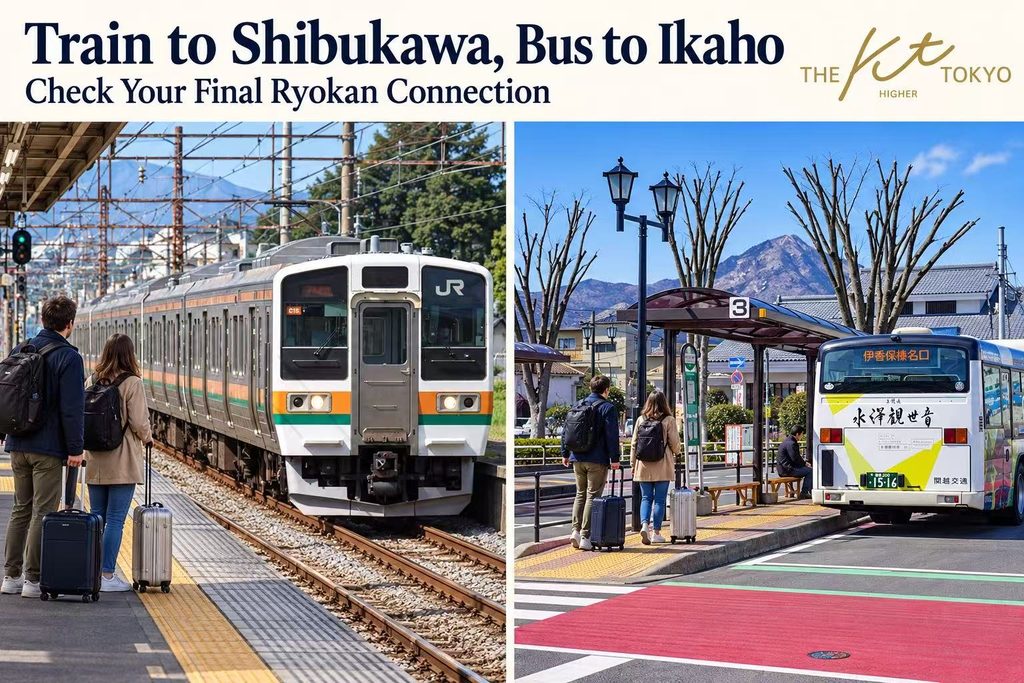
The local bus leaves from Shibukawa Station’s No. 3 boarding area. Its journey to the stone-step area takes approximately 25 minutes. Ordinary JR seats do not require reservations; seats are not guaranteed.
For a bus-focused journey, travel from Haneda Terminal 3 to Busta Shinjuku, then change to an Ikaho-bound Yumeguri service.
Total reference fare: ¥4,200–¥4,500 per adult.
Changes: one at Busta Shinjuku.
The Shinjuku–Ikaho section takes approximately 2½ hours on the published timetable. Allow roughly 4–5½ hours overall when combining the airport bus, a sensible transfer margin and the onward service.
Reserve the highway bus and check the airport bus’s exact stopping point. A service ending at Shinjuku Station West Exit requires a walk to Busta Shinjuku. Road congestion can affect both journeys.
A seasonal service is advertised from Haneda Airport Garden to Ikaho for November 1, 2026–May 5, 2027.
The published outbound schedule leaves Airport Garden at 10:20 and reaches Ikaho Ishidangaiguchi at 14:35.
Airport Garden’s bus terminal is connected to Terminal 3 by a walkway. It is separate from the airport terminal’s usual bus boarding area.
This published operating period does not cover October 19. Check the operator’s booking system for your actual date and fare before planning around it.
A taxi can take you to your accommodation, but this is a substantial long-distance fare.
Estimated fare: approximately ¥60,000–¥70,000 per vehicle for a daytime, ordinary-road reference journey.
This broad estimate uses a published road reference of approximately 154 km from Haneda Terminal 2 to an Ikaho hotel. It is not an exact Terminal 3 quotation or an expressway fare.
Tokyo’s current upper-limit ordinary taxi tariff starts at ¥500 for 1 km, then adds ¥100 per 232 meters. The published tariff also includes a long-distance discount.
Expressway routing changes the distance and adds tolls. Low-speed travel, waiting, dispatch charges and the 22:00–05:00 surcharge can change the total. Ask the taxi operator to confirm the route, journey time and expected charge before departure.
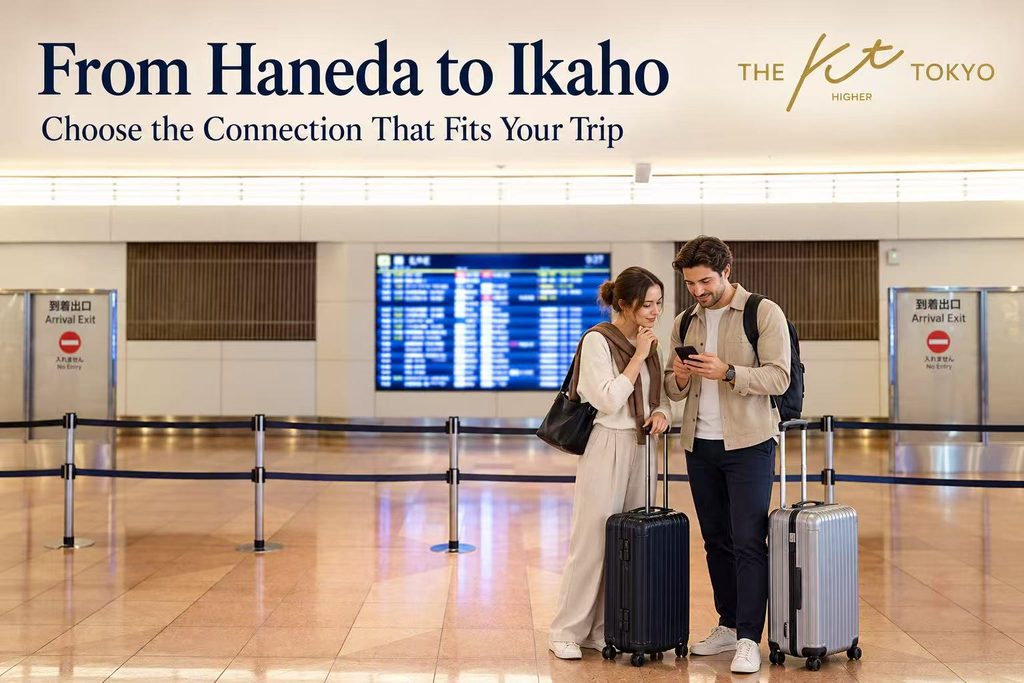
From Narita Terminal 1, one option is the Skyliner to Keisei-Ueno, followed by JR trains and the local Ikaho bus.
Travel in this order:
The Skyliner price includes the ¥1,280 paper-ticket base fare and ¥1,300 reserved-seat liner charge.
The JR conventional-rail fare from Ueno through Takasaki to Shibukawa is ¥2,420.
Total reference fare: ¥5,750 per adult.
Changes: three, including the walk between the two Ueno stations.
Planning allowance: approximately 4–5 hours, including ordinary connection time and the Ueno station walk. This excludes airport arrival procedures and your final accommodation transfer.
Skyliner seats are reserved. The ordinary JR trains and local bus do not provide reserved seating. Keep your luggage manageable for the station walk and connections.
A bus-focused option starts outside Narita Terminal 1 and connects at Shinjuku.
Total reference fare: ¥6,400–¥6,700 per adult.
Changes: one at Shinjuku.
Allow approximately 4½–6 hours with a workable connection. Heavy traffic or a long wait can extend the journey considerably.
Choose an airport bus serving Busta Shinjuku where possible. If it terminates at Shinjuku Station West Exit, include the additional walk.
Book the onward highway bus separately. The two tickets do not create a protected connection, so avoid a tight transfer after an international flight.
A direct Narita–Ikaho service was not verified for this guide.
Estimated fare: approximately ¥83,000–¥90,000 per vehicle for a daytime, ordinary-road reference journey.
The distance benchmark is approximately 184 km from Narita Terminal 2’s parking area to Ikaho Onsen. Terminal 1 pickup, your ryokan address and a different road route change the calculation.
The Chiba taxi association lists a Narita tariff of ¥500 for the first 1.06 km, then ¥100 per 221 meters.
This estimate is based on road distance and the published tariff. It is not a fixed-price offer. Toll roads, waiting, low-speed charges and the 22:00–05:00 surcharge require separate consideration.
The airport’s published Tokyo-zone fixed fares should not be assumed to apply to Ikaho. Confirm long-distance acceptance, luggage capacity, travel time and the fare basis with the taxi company.
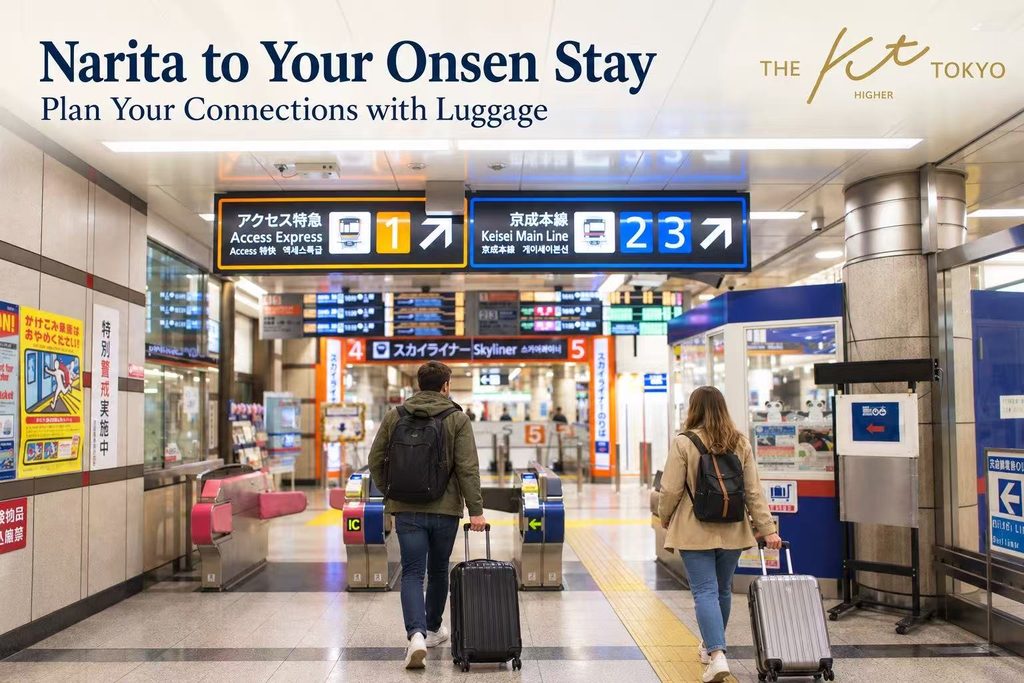
Travel from Tokyo Station to Takasaki on a suitable direct JR Ueno–Tokyo Line service. Change for Shibukawa, then take the local bus to Ishidangaiguchi.
Total reference fare: ¥3,170 per adult.
Changes: two, at Takasaki and Shibukawa, when using suitable through services.
Allow approximately 3–4 hours with connections. Your hotel transfer follows separately.
A Shinkansen to Takasaki or the reserved-seat Kusatsu-Shima limited express from Ueno offers another rail option. Those services require additional charges and are not included in the ¥3,170 example.
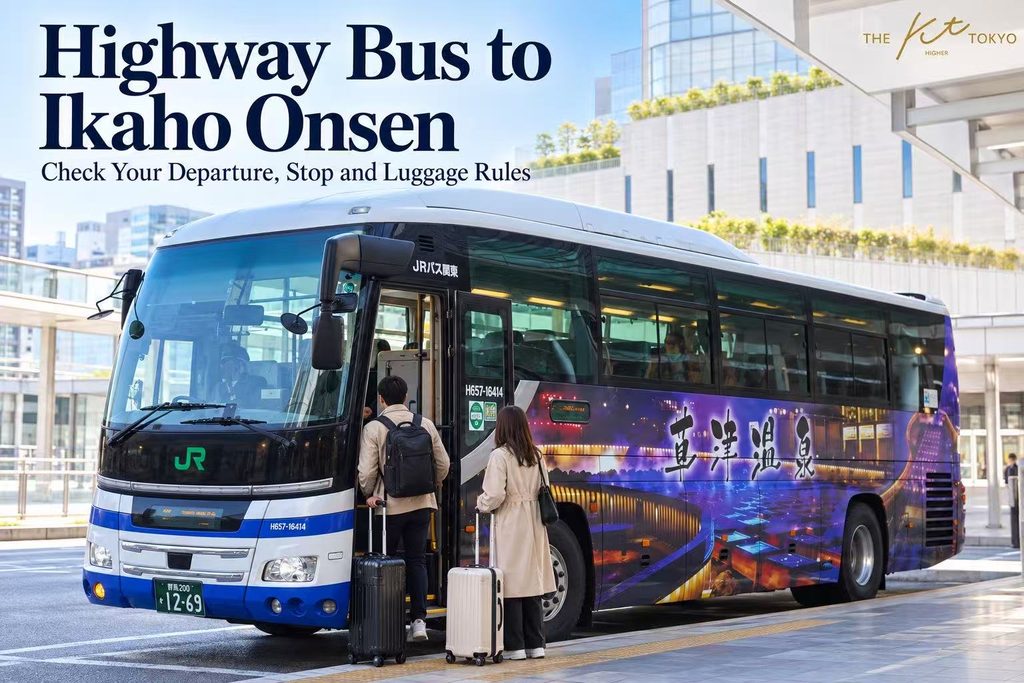
Yumeguri highway services connect Tokyo Station Yaesu South Exit and Busta Shinjuku with Ikaho.
Regular advance fares are approximately ¥2,800–¥3,100 per adult. Selected discounted tickets may be available, with separate conditions and limited availability.
Published journeys take approximately 2½ hours. Check the individual departure, operating day and Ikaho stop when booking.
These services avoid a train-to-local-bus connection. However, they follow a fixed timetable and remain subject to road congestion.
Check the official Yumeguri timetable and fares
Airport and intercity buses have different luggage rules. Acceptance on the first bus does not guarantee acceptance on the next.
For JR Bus Kanto’s applicable “other routes” category, the published trunk allowance is approximately one item per person. Limits include 30 kg, a combined three-side measurement of 250 cm and a maximum length of 2 meters.
These are operator-specific limits, not a guarantee of spare trunk space. Joint operators may apply different conditions. Ask about multiple large suitcases, strollers or unusually bulky items before buying tickets.
Yes. You can continue from one resort stay to another, although public transport may involve returning toward Tokyo.
Hakone and the Fuji Five Lakes area cover wide regions. Start planning with your exact accommodation rather than the regional name alone.
One public transport option is:
Hakone-Yumoto → Shinjuku by a direct Odakyu Romancecar → walk to Busta Shinjuku → Ikaho by highway bus.
Romancecar services generally take around 1½ hours to Shinjuku. Combined with the Ikaho bus and a sensible transfer margin, allow roughly 4½–5½ hours from Hakone-Yumoto.
This excludes your hotel-to-station journey and the final transfer in Ikaho. Romancecar travel requires both a base-fare ticket and a reserved-seat limited-express ticket.
For a car comparison, a published toll-road route from Hakone-Yumoto to Fukuichi in Ikaho is approximately 194 km, with a baseline driving estimate of 2½ hours. Breaks, congestion, weather and different hotels add time.
One public transport option is:
Kawaguchiko Station → Busta Shinjuku by highway bus → Ikaho by a separately booked highway bus.
Allow roughly 5–6 hours with a suitable connection. Congestion on either road section can extend this.
Check the official Kawaguchiko–Shinjuku bus information
A possible driving corridor uses the Chuo Expressway, Ken-O Expressway and Kan-Etsu Expressway. A published interchange-to-interchange reference is approximately 174 km between Kawaguchiko IC and Shibukawa-Ikaho IC.
That figure excludes the local roads from your accommodation and the approach to your Ikaho ryokan. It is not a hotel-to-hotel distance.
A private car can connect the two accommodations without changing vehicles. The higher cost should be weighed against luggage handling, family needs and the time available for your transfer day.
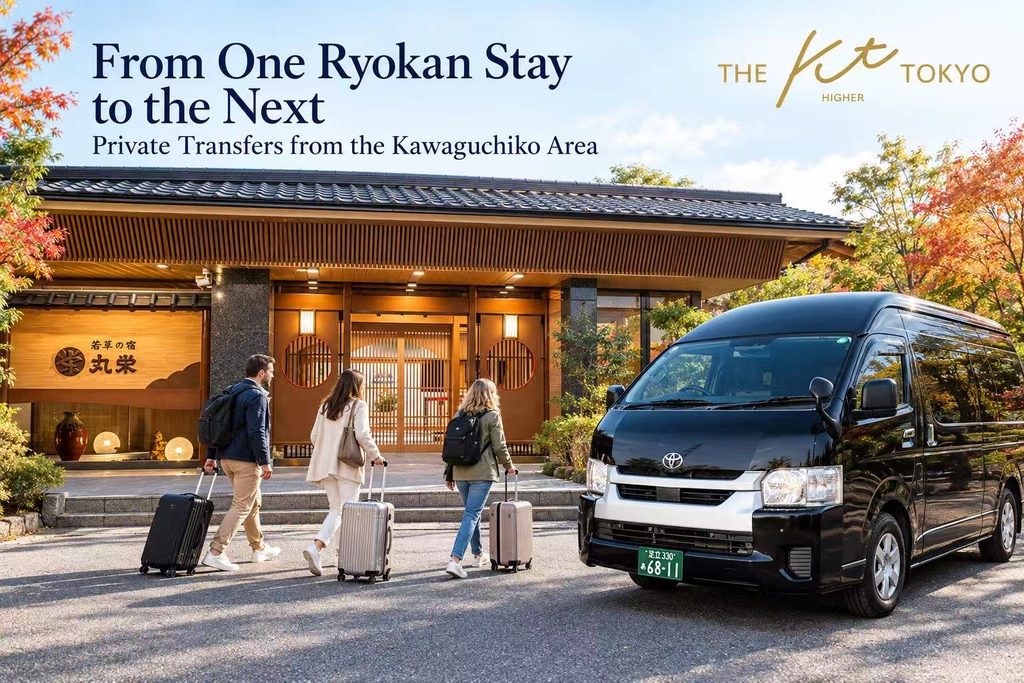
KT Hire can discuss private transfers from Tokyo hotels, Haneda Airport, Narita Airport, Hakone and the Kawaguchiko area to your Ikaho accommodation.
Pickup and drop-off are arranged using the properties’ permitted vehicle access. If an entrance is inaccessible, an alternative meeting point is agreed beforehand.
Toyota Alphard and Toyota HiAce vehicles are available for consultation. The recommendation depends on passengers, suitcase sizes, strollers and child-seat requirements.
A vehicle’s nominal seat count does not confirm space for every passenger and all their luggage.
Complimentary name-board airport meetings can be provided where available. Instructions depend on your airport and terminal.
For KT Hire pickups at Narita Terminal 3, the meeting is arranged at the taxi zone rather than through an arrivals-hall name-board service. Follow the specific instructions supplied for your booking.
Child seats can be prepared following an advance request. Send each child’s age and approximate height or weight so the appropriate arrangement can be checked. Any applicable charge is confirmed with your quotation.

Rest stops can be discussed according to your route, schedule and family’s needs.
You may want a restroom break, coffee or time for a simple meal. On a suitable Kan-Etsu Expressway route, Kamisato Service Area is one possible stop.
The chosen facility depends on the actual road route. Food, drinks and shopping purchases are paid separately, and stopping time adds to the journey.

Conventional trains and local buses may suit travelers who prioritize cost and can comfortably manage their luggage.
A direct highway bus reduces the number of changes from central Tokyo. Its fixed schedule and luggage conditions need to match your plans.
A taxi offers accommodation access, but a long-distance metered fare can be substantial. Confirm the route and expected charge before setting off.
A pre-booked private transfer may suit families, older travelers or groups carrying several suitcases. It usually involves a higher cost than public transport.
Compare the complete journey, including airport connections and the final approach to your ryokan.
For another Gunma hot spring journey, see KT Hire’s Kusatsu transfer guide.
To request a KT Hire quotation, please send:
Please also mention any fixed ryokan dinner time. We can consider it when discussing the departure schedule.
KT Hire will review the route, vehicle requirements and availability before providing a quotation. No standard Ikaho transfer price is assumed in this guide.
Use the contact options on KT Hire’s official English website to send your plans.
Whether you choose rail, bus or private transportation, a well-planned arrival leaves more time to enjoy your Ikaho stay.

From Tokyo Station, conventional JR trains connect through Takasaki to Shibukawa. The local bus then continues to Ishidangaiguchi. The reference total is ¥3,170 per adult. Direct highway buses also operate from Tokyo Station and Busta Shinjuku, with regular advance fares around ¥2,800–¥3,100.
The conventional-rail examples cost approximately ¥3,500 from Haneda Terminal 3 and ¥5,750 from Narita Terminal 1, including the local Ikaho bus. Airport-bus connections through Shinjuku total approximately ¥4,200–¥4,500 from Haneda and ¥6,400–¥6,700 from Narita. Final accommodation transport is additional.
Yes, subject to route and vehicle availability. KT Hire can assess accommodation-to-accommodation transfers after checking your exact hotels, date, passengers and luggage.
Yes. Request child seats in advance and provide each child’s age and approximate size. Rest stops can be arranged around the route and schedule. Child-seat charges, if applicable, are confirmed in the quotation; food and drinks are paid separately.
Broad daytime taxi estimates are approximately ¥60,000–¥70,000 from the Haneda area and ¥83,000–¥90,000 from the Narita area, using the ordinary-road references explained above. These are per vehicle, not fixed offers. Different routes, tolls and surcharges change the total. KT Hire provides a separate itinerary-based quotation.
Published: October 14, 2026
URL: https://kt-hire.co.jp/tokyo-to-kusatsu-onsen-private-transfer/
Explore another Gunma hot spring destination and the practical considerations for traveling directly to your accommodation.
Published: September 18, 2026
URL: https://kt-hire.co.jp/takaragawa-onsen-private-transfer-tokyo-airport/
Discover additional mountain onsen destinations and ideas for airport-to-ryokan travel with luggage.
Published: September 14, 2026
URL: https://kt-hire.co.jp/tokyo-airport-japan-onsen-private-transfer/
Consider how airport transfers and hotel-to-hotel journeys can connect a longer Japan resort itinerary.